
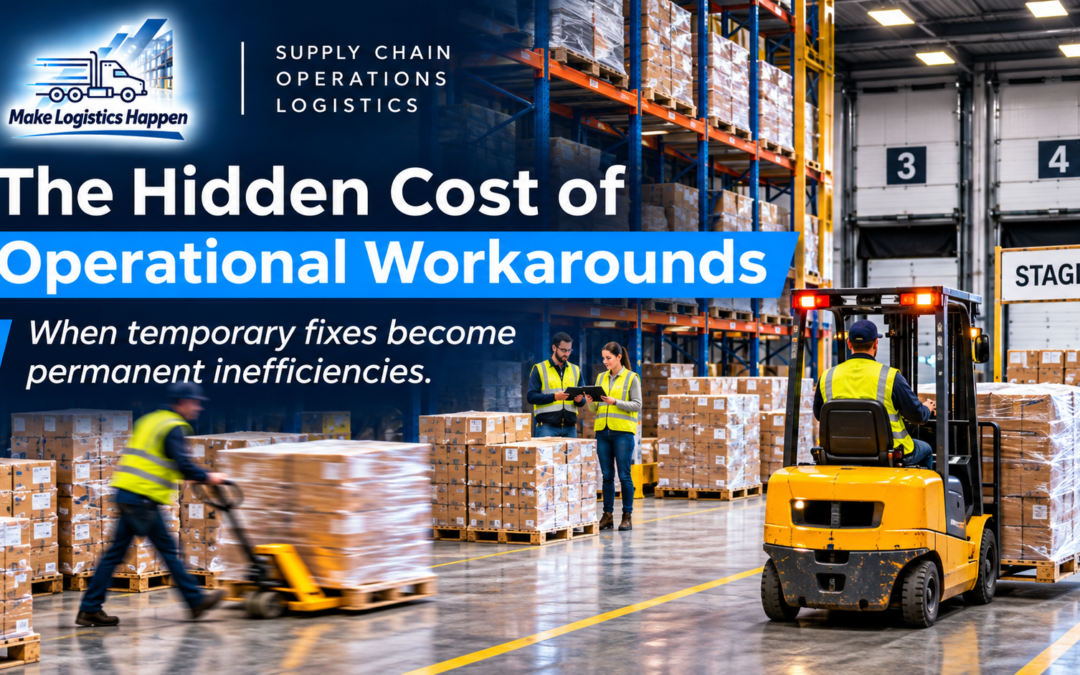
How temporary fixes become permanent inefficiencies in warehousing, transportation, and distribution.
Operational workarounds are a reality in nearly every logistics operation. Whether in warehousing, transportation, or distribution, employees routinely develop temporary solutions to overcome process limitations, maintain service levels, and keep freight moving.
A spreadsheet compensates for a system limitation. An additional handling step addresses an inventory discrepancy. A second shift absorbs work that the first shift cannot complete. An experienced employee develops an informal process to keep a customer order moving.
In many cases, these adjustments are necessary. They protect service levels, resolve immediate problems, and allow operations to continue despite imperfect conditions.
The challenge begins when temporary solutions become permanent operating practices.
Over time, these workarounds can introduce unnecessary labour, additional handling, inconsistent processes, and costs that gradually become accepted as part of doing business.
What initially helped an operation succeed can eventually prevent it from improving.
For organizations seeking sustainable operational improvement, identifying and eliminating unnecessary workarounds can be just as valuable as investing in new technology, equipment, or facilities.
Why Operational Workarounds Develop and Become Permanent
Most operational workarounds are not created because employees want to bypass established procedures.
They develop because the existing process cannot consistently accommodate the realities of daily operations.
A warehouse management system may not reflect the physical movement of inventory. Inbound appointments may not align with available receiving capacity. Transportation schedules may be disconnected from warehouse readiness. Customer requirements may change faster than standard operating procedures can be updated.
When these gaps emerge, employees find ways to keep the business moving.
An experienced supervisor may introduce a manual tracking process. Warehouse employees may reposition inventory to compensate for inefficient slotting. Transportation coordinators may make repeated scheduling adjustments to overcome poor communication between departments.
These actions often demonstrate initiative and operational knowledge.
However, the fact that a workaround successfully resolves an immediate problem does not necessarily mean it represents the most effective long-term solution.
The distinction matters.
A workaround addresses the symptom. Sustainable operational improvement addresses the underlying cause.
Five Areas Where Workarounds Create Hidden Costs
1. Additional Labour Becomes the Default Solution
When an operation struggles to meet daily requirements, adding labour is often the most immediate response.
Overtime is authorized. Temporary employees are introduced. Additional shifts are scheduled.
These measures may be necessary during seasonal peaks or unexpected demand increases.
But when additional labour becomes a permanent requirement, it is worth examining whether the underlying operating process is functioning effectively.
Poor inventory placement, excessive travel distances, inconsistent receiving schedules, and unnecessary handling can all increase labour requirements without increasing productive output.
The critical question is not simply whether the operation has enough people.
It is whether existing labour is being deployed against an efficient process.
Without that distinction, organizations risk building recurring inefficiencies into their labour budgets.
2. Manual Processes Compensate for System Limitations
Spreadsheets, email chains, and informal tracking tools are common throughout logistics operations.
They often emerge because existing systems do not provide the visibility or functionality employees need.
A transportation coordinator maintains a separate shipment tracker. A warehouse supervisor manually reconciles inventory discrepancies. Customer service personnel rely on independent spreadsheets to monitor outstanding orders.
These tools may provide short-term visibility, but they can also introduce duplicate data entry, inconsistent information, and dependence on individual employees.
As the business grows, manual processes become increasingly difficult to maintain.
The answer is not necessarily a new software platform.
Before investing in technology, organizations should determine whether the problem originates from system functionality, configuration, data accuracy, process design, or inconsistent system utilization.
Technology should support an effective operating process rather than automate an inefficient one.
3. Unnecessary Material Handling Becomes Routine
Every additional movement of inventory consumes time, equipment capacity, and labour.
Yet many warehouses gradually develop handling practices that add little operational value.
Inbound products may be staged multiple times before putaway. Inventory may be relocated repeatedly to accommodate poor storage configurations. Orders may require additional touches because picking and consolidation processes are not properly aligned.
These activities can become so familiar that they are no longer questioned.
The operation continues to function, but productivity suffers.
Reducing unnecessary touches requires examining the complete movement of products through the facility, from receiving and storage to picking, staging, and outbound loading.
The objective is not simply to move inventory faster.
It is to eliminate movements that should not be necessary.
4. Transportation Exceptions Become Standard Practice
Transportation operations are particularly vulnerable to recurring workarounds.
Missed pickup windows, incomplete shipment information, inconsistent order readiness, and last-minute scheduling changes can generate significant administrative activity.
Dispatchers and transportation coordinators become skilled at resolving these exceptions.
However, the organization’s ability to manage recurring disruptions can conceal the fact that those disruptions should not be occurring as frequently.
A warehouse that consistently misses carrier departure windows may require more than improved dispatch communication.
The underlying issue could involve order release timing, picking productivity, dock scheduling, labour allocation, or coordination between transportation and warehouse operations.
Similarly, recurring detention, demurrage, and accessorial charges may reflect process failures rather than unavoidable transportation expenses.
When exceptions become predictable, they should be treated as opportunities for process improvement rather than simply accepted as part of normal operations.
5. Operational Knowledge Becomes Concentrated in Individuals
Experienced employees are essential to successful logistics operations.
They understand customer requirements, recognize emerging problems, and know how to navigate complex operational environments.
However, organizations can become overly dependent on individuals who possess knowledge that has never been incorporated into formal processes.
A supervisor knows which inventory discrepancies require special attention. A dispatcher understands which customer locations routinely create delivery challenges. A receiving employee knows how to resolve recurring documentation problems.
When these solutions exist only in individual experience, operational consistency becomes vulnerable.
Absences, employee turnover, or business growth can expose weaknesses that were previously concealed by experienced personnel.
Standard operating procedures should capture effective practices, establish accountability, and support consistent execution.
The goal is not to eliminate employee judgment.
It is to ensure that operational performance does not depend entirely on informal knowledge.
A Practical Example: Rethinking Inbound Receiving
In one distribution operation, inbound freight management had become a recurring source of operational pressure.
Container arrivals, receiving schedules, unloading practices, and coordination with transportation providers were creating avoidable complexity and additional costs.
Rather than continuing to manage these challenges through scheduling adjustments and exception handling, the operation reviewed how inbound freight was being received and processed.
A key improvement involved introducing live unloading practices and improving coordination between inbound planning, warehouse operations, and transportation activities.
The objective was to address the underlying process rather than repeatedly managing the consequences.
These changes helped reduce exposure to detention, demurrage, storage, and drayage costs while improving the movement of inbound freight through the operation.
The lesson extends beyond container receiving.
When an operation repeatedly spends time and money managing the same exceptions, the underlying process deserves closer examination.
What appears to be a transportation problem may originate in warehouse execution, receiving practices, or poor coordination between operational functions.
Resolving those issues can create benefits across the broader supply chain without requiring additional facilities or significant capital investment.
When Operational Workarounds Become Execution Debt
The cumulative effect of unresolved workarounds extends beyond individual processes.
As temporary fixes accumulate, they create a widening gap between how an operation was designed to function and how it actually performs.
This is closely related to execution debt: the operational burden created when underlying process problems remain unresolved while the business continues to adapt around them.
A workaround introduced to protect customer service may eventually increase labour requirements.
An additional inventory-handling step may reduce immediate congestion while creating downstream inefficiencies.
A manual reporting process may improve short-term visibility while introducing unnecessary administrative work.
Individually, these adjustments may appear manageable.
Collectively, they can reduce operational flexibility, increase costs, and make future improvements more difficult to implement.
The longer these practices remain embedded in daily operations, the more likely they are to be viewed as unavoidable requirements rather than opportunities for improvement.
The Financial Impact Is Often Hidden in Plain Sight
One reason operational workarounds persist is that their costs are rarely consolidated into a single financial category.
Additional labour appears in payroll expenses.
Extra inventory movements are absorbed into warehouse productivity.
Transportation exceptions appear as accessorial charges or administrative effort.
Manual reporting consumes management time without necessarily generating a separate expense line.
As a result, organizations may recognize individual cost pressures without identifying the common process failures contributing to them.
This is where operational and financial analysis need to intersect.
Labour productivity, cost per order, handling frequency, dock-to-stock time, transportation accessorials, and service exceptions can provide valuable insight into the cost of established practices.
The objective is to distinguish between activities that create customer value and activities that exist primarily to compensate for process deficiencies.
Eliminating unnecessary work can improve profitability without requiring corresponding increases in revenue or capital investment.
Why Employees May Resist Eliminating Workarounds
There is an important human element to operational improvement.
Employees often take pride in the solutions they have developed.
A manual process may have prevented service failures. An additional handling step may have reduced inventory errors. A scheduling adjustment may have helped the operation navigate difficult customer requirements.
When management challenges these practices, employees may interpret the discussion as criticism of their judgment or performance.
That response is understandable.
Effective operational improvement begins by recognizing why a workaround was introduced and the problem it was intended to solve.
Employees closest to the work frequently understand the underlying constraints better than anyone else.
Their knowledge should be incorporated into the improvement process.
The objective is not to assign blame for past decisions.
It is to determine whether the original problem still exists and whether a more effective solution is now available.
How to Identify and Eliminate Unnecessary Workarounds
Organizations do not need to launch a large transformation initiative to begin addressing operational workarounds.
Professional organizations such as the Association for Supply Chain Management (ASCM) provide additional resources on process improvement, operational performance, and supply chain management.
A focused review of daily execution can reveal meaningful opportunities.
Start by observing how work actually happens.
Compare documented procedures with the steps employees follow during a normal operating day.
Identify where manual intervention, additional approvals, repeated handling, or informal communication are required to complete routine activities.
Ask why each workaround exists.
Determine what problem it was originally intended to solve.
Was it a system limitation, customer requirement, staffing constraint, inventory issue, or process design weakness?
Understanding the original purpose is essential before attempting to eliminate the activity.
Measure the operational impact.
Evaluate the labour hours, handling activity, delays, exceptions, and costs associated with recurring workarounds.
Not every workaround justifies immediate intervention.
Prioritize those that create measurable financial exposure, service risk, or operational complexity.
Redesign the underlying process.
Where possible, address the cause rather than removing the workaround in isolation.
Eliminating a manual inventory check without correcting the inventory accuracy problem, for example, may introduce greater operational risk.
Standardize and sustain the improvement.
Update operating procedures, clarify responsibilities, establish relevant performance measures, and ensure employees understand the revised process.
Improvements should become part of daily operational management rather than temporary project outcomes.
Operational Improvement Does Not Always Require More Resources
One of the most persistent assumptions in logistics is that increasing demand must be met with additional resources.
More warehouse space.
More equipment.
More employees.
More technology.
Sometimes these investments are justified.
However, organizations should first understand whether their existing resources are being consumed by unnecessary work.
A facility may have sufficient physical capacity but suffer from poor inventory flow.
A transportation operation may have adequate carrier capacity but struggle with inconsistent shipment readiness.
A distribution centre may have enough labour hours but lose productivity through repeated handling and inefficient processes.
In each case, the apparent resource constraint may be partly the result of how the operation is functioning.
Before committing additional capital, it is worth determining whether existing resources can deliver better results through improved execution.
The Value of an Operator-Led Perspective
Identifying operational workarounds requires more than reviewing procedures or analyzing performance reports.
It requires understanding how work moves through an operation, why employees make certain decisions, and where process failures create downstream consequences.
An operator-led approach combines firsthand operational experience with structured analysis.
It examines warehouse activity, transportation coordination, inventory flow, labour deployment, and customer requirements as connected parts of the same operating environment.
This perspective helps distinguish between practices that are genuinely necessary and those that have continued simply because nobody has challenged them.
At Make Logistics Happen, our focus is on identifying practical opportunities to improve execution, reduce unnecessary costs, and make better use of existing operational resources.
Because sustainable improvement is not always about introducing something new.
Sometimes it begins by eliminating work that should never have become permanent.
Final Thoughts
Operational workarounds are not inherently bad.
They are often necessary responses to immediate challenges, and many originate from employees demonstrating initiative, experience, and commitment to customer service.
The problem develops when organizations stop questioning whether those temporary solutions are still necessary.
Over time, workarounds can become embedded in operating procedures, labour budgets, transportation practices, and management expectations.
The resulting inefficiencies may be difficult to recognize precisely because they have become familiar.
Organizations that regularly challenge these practices can uncover opportunities to improve productivity, strengthen service performance, and reduce costs without automatically increasing resources.
The question is not whether your operation has workarounds.
It’s whether those workarounds are still solving problems—or have become problems themselves.
About the Author
Philip Dowhan is Managing Director of Make Logistics Happen, an operator-led logistics consulting business focused on warehouse optimization, transportation solutions, distribution operations, and supply chain execution.
With more than 20 years of experience across Canadian and U.S. logistics operations, Philip has led operational improvements, distribution initiatives, transportation implementations, and performance optimization programs across multiple industries.
Make Logistics Happen helps organizations identify operational inefficiencies, improve execution, and create measurable business value through practical, experience-driven solutions.