
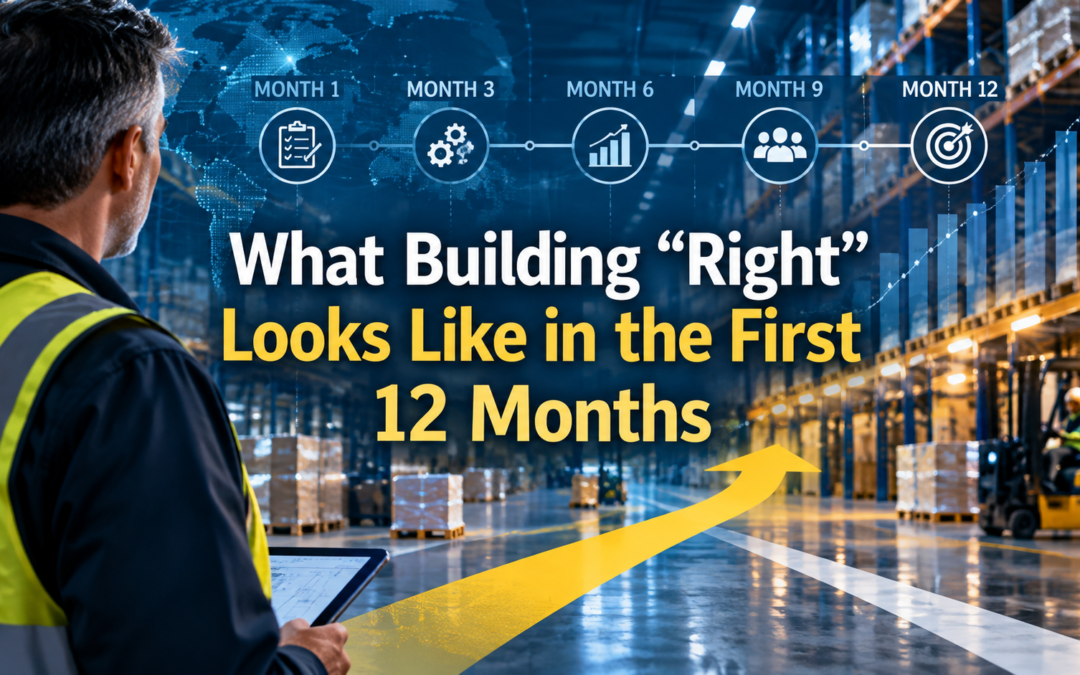
The first year of any warehousing and distribution operation is decisive.
Not because everything has to be perfect, but because the standards you set early become the habits you live with later. In logistics, early shortcuts do not disappear as you grow. They multiply.
After years inside warehouse and transportation operations, one pattern has shown up consistently:
the most painful problems in mature operations can usually be traced back to decisions made in the first 12 months.
Building “right” early is not about speed or ambition.
It is about discipline.
Here is what that looks like to me.
Process Before Volume
Volume has a way of exposing everything.
Before adding customers or throughput, the operation itself needs to flow cleanly:
Receiving must be controlled and repeatable
Putaway must support accuracy and access
Picking must be logical and efficient
Shipping must be consistent and measurable
If volume exposes gaps, that is feedback, not a signal to push harder.
Strong operations do not rely on heroics.
They rely on processes that work on good days and bad ones.
Training as an Investment, Not a Cost
The first hires define the culture.
Building right in year one means treating training as infrastructure, not overhead:
Clear onboarding
Defined expectations
Standard work
Accountability from day one
When training is rushed, inconsistency becomes permanent.
When expectations are unclear, performance becomes subjective.
Time spent training early saves exponentially more time later and protects service quality as the operation grows.
Visibility Built In, Not Bolted On
If you cannot see what is happening, you cannot manage it confidently.
Inventory accuracy, order status and performance metrics should not be reactive tools used during problems, they should be built into daily operations.
That means:
Clear inventory ownership
Regular reconciliation
Simple, meaningful KPIs
Visibility that supports decisions, not noise
Visibility is not about dashboards.
It is about trust in the data.
Choosing Customers Carefully
Not every opportunity belongs in the first year.
The right early customers:
Fit the operating model
Communicate clearly
Understand constraints
Value partnership over price alone
Early misalignment creates friction that never fully disappears.
The wrong customer does not just add complexity, they reshape the operation in ways that are hard to undo.
Building right means being selective, even when growth is tempting.
Controlled Growth Over Fast Growth
Growth should strengthen the operation, not strain it.
That means:
Scaling capacity deliberately
Adding complexity only when it is necessary
Saying no when timing is not right
Fast growth without control leads to constant firefighting.
Controlled growth builds confidence, consistency and credibility.
In logistics, stability is a competitive advantage.
Setting Standards That Last
The first 12 months are not about perfection.
They are about:
Establishing how work gets done
Defining what “good” looks like
Creating habits that scale
Building trust with customers and teams
Get those right and growth becomes easier.
Get them wrong and growth becomes painful.
Looking Ahead
Building “right” does not mean standing still.
It means moving forward with intention.
As Make Logistics Happen continues from vision into motion, the focus remains on fundamentals. Strong foundations do not slow progress. They make it sustainable.
The goal is not just to build something that works today.
It is to build something that still works years from now.