
Editor’s Note — October 2026
This article was written while Make Logistics Happen was evaluating several potential directions, including the possibility of establishing its own logistics operations.
Today, MLH is focused on operator-led logistics consulting, helping existing 3PL, warehousing, distribution and transportation businesses identify operational challenges, improve productivity, uncover capacity and strengthen profitability.
The principles discussed below—recognizing recurring problems, understanding customer expectations, assessing operational resilience and establishing alignment before making commitments—continue to guide our consulting work.
In logistics, the most costly mistakes are rarely dramatic.
They do not usually come from bad intentions or poor effort.
They come from committing too early, before the signals are clear.
As Make Logistics Happen moves from vision into motion, I am intentionally slowing down the decision-making, even as momentum starts to build. Not to stall progress, but to ensure that when commitments are made, they are durable.
This phase is about observation. About listening carefully. About identifying patterns before locking in direction.
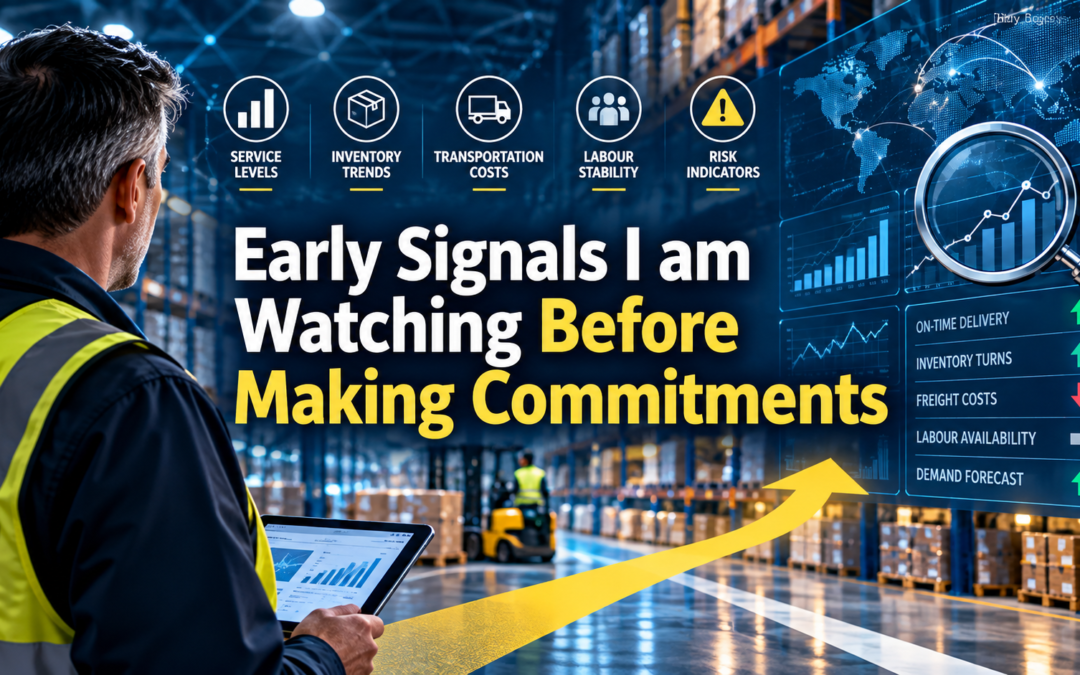
Here are the early signals I am paying the closest attention to before making meaningful commitments.
1. Consistency in Customer Pain
One-off complaints are noise.
Repeated pain points are signals.
Across conversations with shippers, operators and business leaders, I am listening for recurring themes, such as:
Lack of visibility into inventory and order status
Rigid 3PL models that don’t adapt as businesses grow
Poor communication when things go wrong
A lack of ownership once a contract is signed
When the same issues surface across industries and company sizes, it tells me the problem is not execution at the edges, it is structural.
Those patterns matter.
2. How Shippers Talk About Their Current Partners
What people say is important.
How they say it is even more revealing.
I am paying attention to frustration around:
Accountability (“We cannot get a straight answer”)
Responsiveness (“Everything takes too long”)
Ownership (“It feels like we are on our own once there is an issue”)
Price comes up, but rarely first.
Most dissatisfaction stems from trust and reliability, not rates.
That is a signal worth respecting.
3. Behaviour Under Pressure
Peak season, labour shortages, service failures and pressure changes behaviour.
I am watching closely how operations respond when things go wrong:
Do systems hold, or do they collapse?
Do teams adapt, or freeze?
Do partners step up, or disappear?
Stress reveals truth about processes, leadership and culture.
Any commitment I make has to be resilient under pressure, not just functional on good days.
4. Willingness to Change, Not Just Outsource
Some organizations want better outcomes.
Others want the same outcomes with less responsibility.
I am looking for partners who are:
Open to changing how work gets done
Willing to invest in better processes
Interested in collaboration, not just handoff
A successful logistics partnership requires shared ownership.
If that mindset is not present early, it rarely appears later.
5. Alignment Before Urgency
Urgency can be persuasive, but it is often misleading.
Before committing, I am asking:
Are expectations clearly defined?
Is success measured the same way on both sides?
Is this decision built for the long term, or just solving today’s pressure?
Urgency creates motion.
Alignment creates progress.
And progress is the goal.
Why Early Signals Matter
Early signals shape long-term outcomes.
They influence:
Which customers you build around
Which processes become standard
Which compromises become permanent
Ignoring signals does not make them go away, it just delays the cost.
This phase of MLH is not about moving fast.
It is about moving right.
Looking Ahead
Commitments will come to facilities, customers, partnerships and timelines.
But they will be made when the patterns are clear, not when the pressure is loudest.
Early signals matter because they protect the foundation before scale magnifies every decision.
That is the discipline I am bringing into this next chapter.