
Editor’s Note — October 2026
This article reflects an earlier stage in the development of Make Logistics Happen, when establishing an operator-led warehousing and distribution business was among the opportunities being considered.
Today, MLH is focused on logistics consulting and operational improvement, helping existing operators uncover capacity, improve productivity, eliminate unnecessary costs and strengthen profitability.
The principles discussed below—selectivity, operational discipline, understanding customer needs and making informed decisions—remain central to our consulting approach.
Vision is important.
It gives direction, purpose and something to build toward.
But vision on its own does not move freight, train teams, or serve customers.
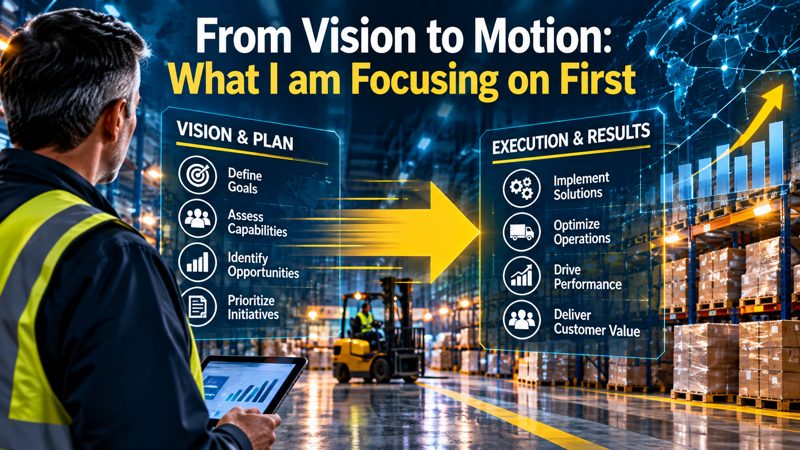
At some point, vision has to turn into motion.
As we move into 2026, Make Logistics Happen is entering that transition, not with urgency or noise, but with intent. This phase is not about announcing everything at once. It is about laying the groundwork properly before committing to scale.
Here is what I am focused on first as MLH moves from vision into motion.
1. Validating the Right Fit — Not Just Any Opportunity
Early momentum can be deceptive.
Not every opportunity is a good one and not every deal is worth chasing.
Right now, the focus is on fit:
Operational fit
Cultural fit
Expectation alignment
Long-term viability
Whether it is a facility, a customer, or a partnership, the question is not “Can this work?”, it is “Should this be the foundation?”
Strong operations are built by saying no as often as saying yes.
2. Getting the Fundamentals Right Before Scaling
Execution does not start with expansion, it starts with discipline.
Before any growth, the fundamentals must be clear:
How flow will work inside the warehouse
How labour will be structured and trained
How inventory will be received, stored and shipped
How visibility and accountability will be maintained
These are not things you fix later without cost.
They are things you get right early, or pay for repeatedly.
This phase is about designing the operation so that when volume arrives, it strengthens the system instead of stressing it.
3. Listening Closely to the Market
Good strategy comes from observation, not assumption.
Right now, I am spending time listening:
To shippers who feel underserved by traditional 3PL models
To operators dealing with rising costs and tighter margins
To customers frustrated by lack of visibility, flexibility, or responsiveness
What is emerging is consistent:
Businesses do not want complexity, they want reliability.
They do not want dashboards, they want answers.
They do not want promises, they want execution.
Those signals are shaping how MLH moves forward.
4. Being Intentional With Timing
There is a temptation at the start of a new year to move fast, to launch, announce and commit publicly.
But in logistics, timing matters as much as action.
Rushing decisions creates fragile systems.
Intentional pacing creates durable ones.
This phase is about:
Allowing ideas to mature
Pressure-testing assumptions
Making decisions that hold up under real operational conditions
Motion does not have to be loud to be real.
What This Phase Is — and Is not
This phase is:
Preparation
Design
Alignment
Discipline
This phase is not:
Over-promising
Scaling prematurely
Chasing momentum for momentum’s sake
The vision has not changed.
What is changing is the level of focus on turning it into something real, one step at a time.
Looking Ahead
Execution will come and when it does, it will be grounded in clarity, not urgency.
This transition from vision to motion is where many ventures stumble, not because they lack ambition, but because they skip the unglamorous work that makes execution sustainable.
At Make Logistics Happen, the goal is not to move fast.
It is to move right.